Introduction
At the largest North American home textiles trade show in 2025, suppliers of crystal velvet drew queues of buyers—from European hotel chains, US online家居 brands, and Southeast Asian bedding distributors. Meanwhile, China’s textile and apparel exports reached US$170.7 billion in the first seven months of 2025, with intermediate textile exports up 2.7% year on year.
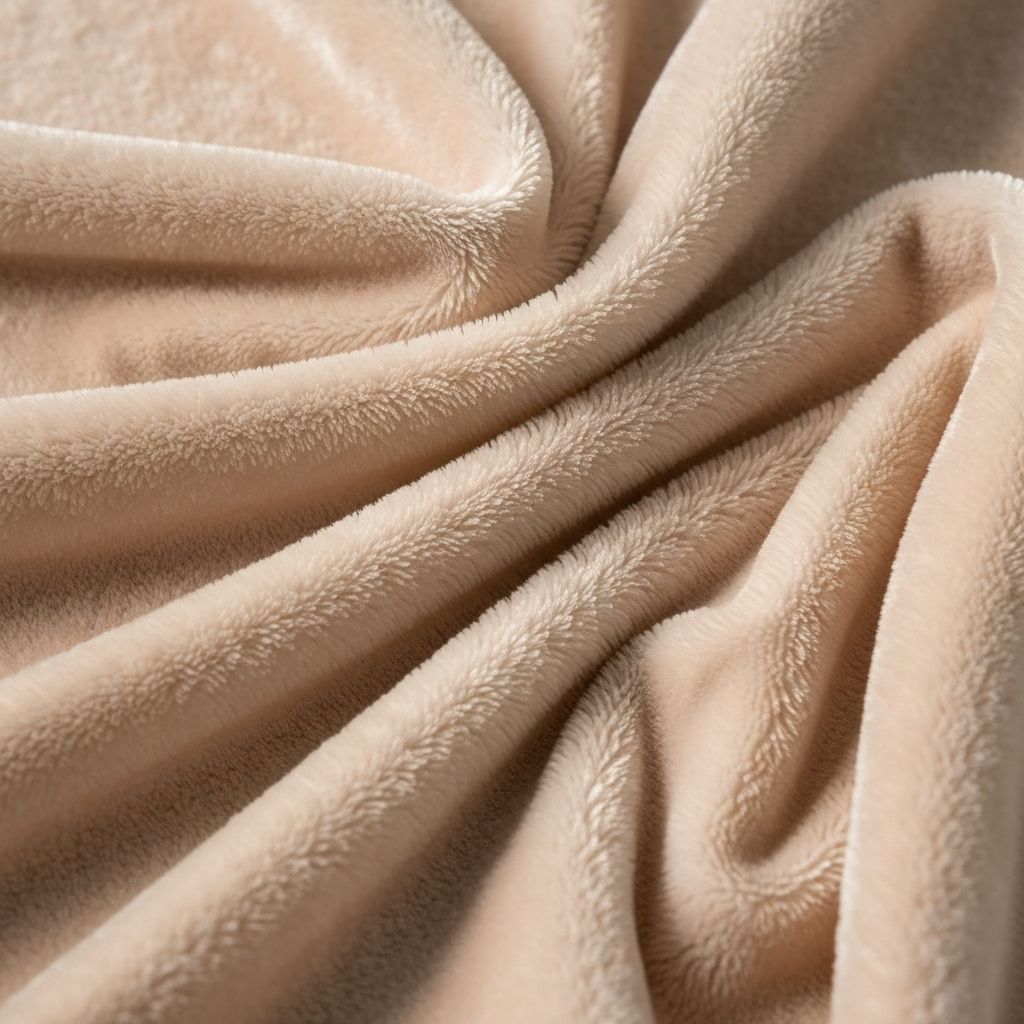
Crystal velvet—a short pile, high gloss polyester fleece—has carved out a distinct niche. It combines visual appeal, easy care, and a cost performance ratio that competing materials struggle to match. This guide examines crystal velvet through the lens of global market data, technical standards (ASTM, ISO, OEKO TEX), and procurement best practices for international buyers.
Table of Contents
What Exactly Is Crystal Velvet? (Definition, structure, key specs)
Technical Performance Parameters (GSM, abrasion, colour fastness, shrinkage)
Global Market Size & Growth (Velvet, polyester fleece, downstream applications)
Crystal Velvet vs. Coral Velvet vs. Flannel (Decision matrix for sourcing)
Compliance & Sustainability Standards (REACH, OEKO TEX, GRS, flame retardancy)
Quality Control Checklist for Buyers (What to test before ordering)
Care & Life Cycle Cost (Washing, drying, maintenance)
Summary & Five Point Action Plan
1. What Exactly Is Crystal Velvet?
Definition and construction
Crystal velvet is a 100% polyester weft or warp knitted fabric that undergoes a multi stage finishing process: raising, combing, shearing, and setting. The result is a short, dense pile (typically 0.5–2 mm) with a distinctive diamond like sheen.
The “crystal” gloss comes from two factors:
The smooth, circular cross section of polyester filaments gives high light reflectance.
Precision shearing levels the pile to within 0.1–0.3 mm, creating an exceptionally flat surface that reflects light uniformly.
Typical technical specifications
Parameter | Typical Value | Test Method / Standard |
Fiber composition | 100% polyester | ISO 18333 (or ASTM D276) |
Weight (GSM) | 150–280 g/m² | ASTM D3776 |
Abrasion resistance (Martindale) | 30,000 – 80,000+ cycles | ASTM D4966 / ISO 12947 |
Abrasion resistance (Wyzenbeek) | 15,000 – 30,000+ double rubs | ASTM D4157 |
Light fastness (xenon arc) | ≥ ISO 4 / 60 hrs | ISO 105 B02 |
Air permeability | 100–300 mm/s | ISO 9237 |
Dimensional stability (shrinkage) | ≤3% length & width | ISO 6330 (5 washes) |
Breaking strength | ≥300 N/5 cm | ISO 13934 1 |
Lightweight crystal velvet (150–180 GSM) is popular for throws and summer blankets; heavier grades (220–280 GSM) are used for winter bedding and upholstery.
2. Technical Performance Parameters — Why They Matter
2.1 Abrasion resistance
Crystal velvet’s short, dense pile gives it significantly better abrasion resistance than longer pile fleece (e.g., coral velvet).
Martindale (ASTM D4966): 30,000–50,000 cycles is typical for commercial grade upholstery. Premium grades can exceed 80,000 cycles.
Wyzenbeek (ASTM D4157): 15,000 double rubs qualifies for general contract use; 30,000+ is high durability commercial grade.
Tip: Always ask for a test report specifying the friction medium (cotton duck or wire mesh) and the number of cycles.
2.2 Colour fastness
Crystal velvet dyes deeply, but dark colours (navy, burgundy, forest green) can fade under prolonged sunlight or industrial laundering.
Fastness Type | Minimum Requirement | Standard |
Light fastness | ≥ ISO 4 (60 hrs) | ISO 105 B02 |
Rubbing (dry) | ≥ ISO 4 | ISO 105 X12 |
Rubbing (wet) | ≥ ISO 3 4 | ISO 105 X12 |
Washing (colour change) | ≥ ISO 4 | ISO 105 C06 |
Overseas buyers shipping to sunny regions (e.g., Mediterranean, South west US) should request an ISO 105 B02 certificate.
2.3 Dimensional stability (shrinkage)
Polyester is inherently stable, but poorly relaxed crystal velvet can shrink >5% after the first wash. Commercial specifications should require shrinkage ≤3% in both warp and weft after five washing cycles (ISO 6330, gentle cycle, low heat drying).
3. Global Market Size & Growth (Data Driven)
Crystal velvet sits at the intersection of three growing markets:
3.1 Global velvet fabric market
2024 value: ~US$1.5 billion
2034 projection: US$2.8 billion (CAGR 6.5%) – source: industry analyst reports
Europe remains the largest regional market; the global luxury fabric market (including velvet) is growing at 11.7% CAGR (2023–2033).
3.2 Polyester fleece fabric market
2025 value: US$987 million
2032 projection: US$1.393 billion (CAGR 5.1%) – demand driven by North America and Europe
3.3 Downstream applications with scale
End use sector | 2024 global value | CAGR (to 2030/34) | Source |
Home textiles & décor | US$86.6 billion | 3.4% | GII Research |
Bedding market | US$49.0 billion | 3.76% | Statista |
Automotive interior materials | ~US$167.8 billion | 5.2% | Research and Markets |
EU 27 bedding market | €11.2 billion | moderate growth | Statista |
Implication: Crystal velvet’s three main export channels—winter bedding sets (US/EU), decorative cushions/throws (hotels & home centres), and car seat covers—all rest on hundred billion dollar demand bases.
4. Crystal Velvet vs. Coral Velvet vs. Flannel — Sourcing Decision Matrix
Property | Crystal Velvet | Coral Velvet | Flannel |
Fiber | 100% microfiber polyester | 100% polyester (DTY 150d/288f) | Polyester/cotton blend or pure polyester |
Pile height | 0.5–2 mm, dense | 3–6 mm, loose | Very short, no visible pile |
Surface gloss | Diamond like, high reflectance | Matte or low sheen | None (cotton like) |
GSM range | 150–280 | 180–300 | 200–350 |
Water absorption | ~3x cotton, quick dry | Moderate, slower drying | Slow |
Shedding / linting | Very low (fibers locked) | Medium high (especially initial washes) | Very low |
Static buildup | Medium (anti static treatment available) | Higher (noticeable in dry air) | Low |
Cost (bulk, per metre) | US1.30–US1.30–US1.80 (≈10 RMB) | Slightly lower or equal | 20–40% higher than coral velvet |
Edge fraying risk | Low | Medium high (long pile pulls out) | Very low |
Best for | Glossy bedding, cushions, auto interior | Budget blankets, children’s products | High warmth, no gloss bedding |
European hotel purchasing data: ~35% of 4 star+ hotels specify crystal velvet or equivalent short pile fleece for winter bedding; coral velvet is more common in economy hotels and mass market retail channels.
5. Compliance & Sustainability Standards — Non Negotiable for Export
5.1 REACH (EU) and OEKO TEX®
Crystal velvet exported to the EU must comply with REACH Regulation (EC) No 1907/2006. The easiest way is to hold OEKO TEX® STANDARD 100 certification, which covers almost all REACH restricted substances (SVHCs, azo dyes, heavy metals, formaldehyde, etc.).
OEKO TEX product class | Application | Typical for crystal velvet |
Class I | Baby textiles | Only if certified |
Class II | Direct skin contact | ✅ Bed sheets, blankets |
Class III | No direct skin contact | ✅ Upholstery, decorative throws |
Class IV | Home textiles / décor | ✅ Cushions, wall hangings |
5.2 GRS (Global Recycled Standard)
If your order specifies recycled polyester (rPET) , every stage of the supply chain (recycling plant → yarn spinner → knitter → finisher) must hold valid GRS certification. Without GRS, the “recycled” claim is legally risky in the EU and North America.
5.3 Flame retardancy — NFPA 701, EN 1021, BS 5852
Requirement | Standard | Typical end use | Cost premium |
Non flame retardant | None | Residential bedding | Baseline |
Chemically treated FR | NFPA 701 (US), CA TB 117 | Contract seating, hotels | +15–30% |
Inherently FR (e.g., Trevira CS) | EN 1021, BS 5852 | High risk public spaces, marine, cruise ships | +40–60% |
Trevira CS (85% CS polyester + 15% flame retardant polyester) is a melt able, inherently FR fibre. Its flame resistance does not wash out, making it ideal for long life commercial interiors.
5.4 EU Strategy for Sustainable Textiles
The EU’s upcoming regulation will require Digital Product Passports (DPP) , stricter limits on microplastic shedding, and mandatory recycled content targets. Buyers should monitor developments and prioritise suppliers with environmental management systems (ISO 14001) and life cycle assessment (LCA) data.
6. Quality Control Checklist for Overseas Buyers
Before signing a purchase order, request the following from your supplier:
# | Test / Document | Accepted standard / pass level |
1 | Abrasion report | Martindale ≥30,000 cycles (ASTM D4966) or Wyzenbeek ≥15,000 double rubs (ASTM D4157) |
2 | Light fastness report | ISO 105 B02 ≥4 (60 hours) – especially for dark colours |
3 | Shrinkage test | ISO 6330 (5 washes) ≤3% in length & width |
4 | Colour fastness to rubbing | Dry ≥4, wet ≥3 4 (ISO 105 X12) |
5 | OEKO TEX certificate | Valid STANDARD 100, product class II, III or IV as needed |
6 | Flame retardant report | NFPA 701 / EN 1021 / BS 5852, depending on destination |
7 | GRS certificate (if rPET used) | Full chain of custody from recycler to finished fabric |
8 | AQL sampling | AQL 2.5 (General Inspection Level II) for major defects |
Note: Testing costs a few hundred dollars per batch. Catching a compliance failure early saves thousands in rejected goods or chargebacks.
7. Care & Life Cycle Cost
Recommended washing instructions
Machine wash cold (≤30°C), gentle cycle
Mild liquid detergent, no fabric softener (softener coats fibres, dulls gloss)
Tumble dry low (≤60°C) or air dry flat – high heat damages the pile
Do not dry clean – chemicals can dissolve fibre finishes
Do not iron – steam from a distance if needed
Life cycle perspective
Crystal velvet’s dirt release and fast drying reduce maintenance labour and energy costs compared to cotton or wool. For hotels and rental properties, lower per use laundry cost often outweighs the slightly higher initial fabric price. Professional velvet cleaning (when needed) is significantly more expensive than cleaning cotton – but crystal velvet rarely requires it.
8. Summary & Five Point Action Plan
Crystal velvet is not a universal fabric, but it solves a specific set of problems exceptionally well: high visual impact + low shedding + durable pile + easy care at a mid range price point.
Key takeaways for professional buyers
GSM defines performance – 150–180 GSM for lightweight throws, 220–280 GSM for winter bedding and upholstery.
Abrasion & light fastness are the two technical gatekeepers – demand Martindale/Wyzenbeek and ISO 105 B02 reports.
Compliance separates serious suppliers – OEKO TEX Class II/IV is the minimum; GRS for recycled content; FR certifications for contract use.
Coral velvet is not a drop in substitute – longer pile means higher shedding and lower gloss. Flannel is warmer but heavier and pricier.
Total cost of ownership favours crystal velvet – low maintenance, quick drying, no pilling, and minimal shrinkage.
Action plan before your next order
Define GSM, pile height, and abrasion cycles in your product specification sheet.
Require ISO 105 B02 light fastness report – especially for dark shades.
Request OEKO TEX certificate (Class II or IV) plus REACH declaration.
For rPET orders, ask for GRS transaction certificates covering all supply chain stages.
Perform AQL 2.5 inspection on first shipment and quarterly thereafter.
Final thought: The global polyester fleece market is growing at 5%+ annually, and crystal velvet is taking share from both coral velvet (at the low end) and natural fibre velvets (at the mid high end). For buyers who verify specs and compliance up front, it offers a rare combination of aesthetics, durability, and supply chain efficiency.
Need Custom Fabric Solutions?
We can customize colors, textures, and specifications to meet your exact requirements.
Contact Us