What's the Difference Between Mink Velvet and Regular Fleece Fabric?
Table of Contents
Introduction
Defining the Two Fabrics
Fiber Composition: The Raw Material Divide
Manufacturing Processes: Where They Diverge
Key Performance Metrics Compared
Comparative Matrix: Mink Velvet vs. Regular Fleece
Application Mapping: Which Fabric for Which Use Case
Cost Analysis & Value Proposition
Care & Longevity Considerations
Summary & Discussion
1. Introduction
Here's something I learned the hard way in textile sourcing: just because two fabrics feel soft doesn't mean they serve the same purpose. Mink velvet and regular fleece (often called polar fleece) are both warm, both polyester-based, and both popular in winter apparel and home textiles. But put them side by side and the differences start showing up fast — in weight, in surface feel, in how they behave after a few washes, and most importantly, in what they cost.
The confusion is understandable. Both fall under the broad "fleece" umbrella. Both involve brushed surfaces designed to trap air for insulation. But mink velvet — also marketed as minky fleece, mink fleece, or cuddle fleece — sits in a noticeably higher tier than standard polar fleece. One is engineered for plush luxury and tactile experience; the other is built for practical warmth, durability, and cost efficiency at scale.
This article breaks down exactly what separates these two fabrics — from fiber composition and manufacturing steps to performance data, pricing realities, and real-world applications. No marketing fluff, just engineering and procurement-level details for B2B buyers who need to make informed decisions.
2. Defining the Two Fabrics
Before comparing, let's get clear on what each fabric actually is.
Mink Velvet (also Minky Fleece / Minky Fabric)
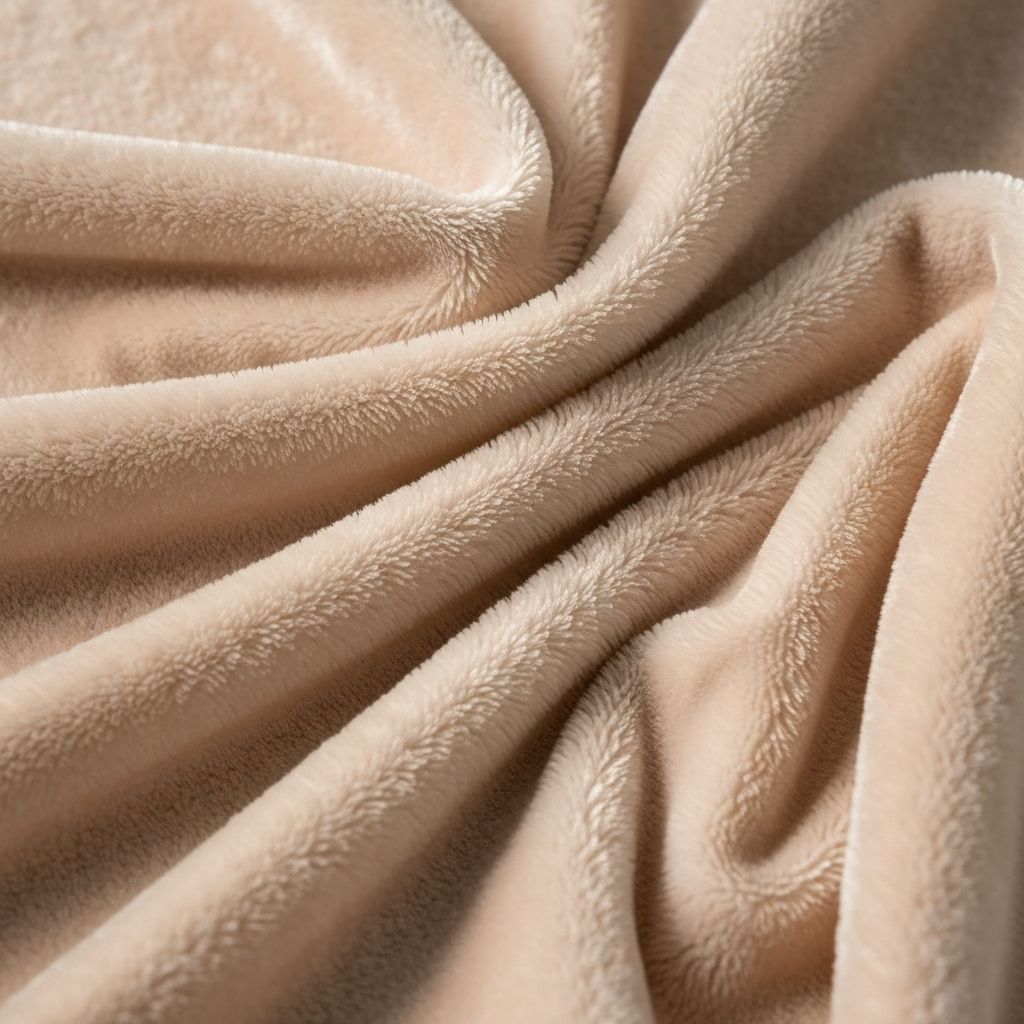
Mink velvet is a plush, microfiber polyester fabric known for its velvety pile and exceptionally soft hand feel. It's typically knit, with a brushed pile on the face and a smoother backing. The name "mink" refers to the fabric's resemblance to mink fur in softness and sheen — not the actual animal. It contains no animal materials of any kind. It is a high-density, ultrafine polyester knitted fleece with a uniform, fine pile and remarkably soft feel. Common variants include dotted/embossed minky fleece, smooth solid types, and printed versions.
Regular Fleece (Polar Fleece)
Polar fleece, on the other hand, is a synthetic, brushed knit textile engineered for warmth, durability, and efficient mass production. Developed in the late 20th century as a wool alternative, polar fleece is typically 100% polyester with a double-sided brushed construction. It is known for excellent warmth-to-weight ratio, moisture-wicking, quick-drying properties, and resistance to wear, pilling, shrinking, and fading. The surface has evenly distributed, relatively sparse fleece particles — what some Chinese manufacturers describe as looking like a "kiwi fruit" texture, whereas mink velvet is likened to a "peach".
Key distinction right upfront: mink velvet is about tactile luxury; polar fleece is about functional performance. But let's go deeper.
3. Fiber Composition: The Raw Material Divide
The raw material selection sets the foundation for everything else.
Mink Velvet Fiber Composition
Mink velvet is typically made from ultra-fine polyester fibers with diameters of approximately 1–3 microns — significantly finer than standard polyester. This microfiber construction is what gives mink velvet its silky, plush feel. Higher-end mink velvet may include blended components. Some formulations incorporate mink fiber, polyester fiber, and spandex fiber — the mink fiber provides softness, lightness, and warmth; polyester adds wear and tear resistance; spandex imparts elasticity for better body conformity and comfort. Others may use blends including raccoon dog hair, rabbit hair, wool, and various chemical fibers.
Regular Fleece Fiber Composition
Polar fleece is typically 100% polyester, including both virgin polyester and recycled PET sourced from post-consumer materials like plastic bottles. Polyester/spandex blends, typically 95/5 or 97/3 ratios, provide enhanced stretch and recovery for activewear applications. The fiber diameter is not as fine as mink velvet's microfiber — standard polyester fibers are thicker, which affects both hand feel and insulation characteristics.
The fiber fineness difference is crucial: finer fibers mean more surface area per unit volume, which translates to better air-trapping capacity and, theoretically, better insulation. But there's a trade-off — finer fibers are also more prone to matting and pilling if not properly engineered.
4. Manufacturing Processes: Where They Diverge
This is where the two fabrics really separate. The production path determines almost everything about the final product.
4.1 Mink Velvet Manufacturing
Mink velvet production follows a specialized sequence:
Knitting. Raw materials are knitted using weft knitting machines or specialized warp knitting equipment (often Raschel knitting) to ensure consistent density and thickness across the fabric.
Napping. The napping process lifts surface yarns to create a pile structure. Pile height and density can be adjusted by intended use, with typical pile heights of 5–15mm.
Shearing. Shearing equipment trims the pile surface to remove long or uneven fibers, ensuring uniform appearance.
Polishing. This is the key step that distinguishes mink velvet from polar fleece. Mink velvet undergoes multiple passes through polishing/calendering machines that create its signature smooth, lustrous surface. Chinese manufacturers describe this extra step as turning a "kiwi fruit" (polar fleece) into a "peach" (mink velvet).
Finishing. Printing, dyeing, and finishing treatments — antistatic, antimicrobial, or environmentally friendly coatings may be applied depending on the end use.
4.2 Regular Fleece (Polar Fleece) Manufacturing
Polar fleece is produced on large circular knitting machines, followed by a series of processes: dyeing, brushing, raising, shearing, and anti-pilling finishing.
Brushing. Unlike mink velvet's single-face focus, polar fleece is typically brushed on both sides, creating a double-sided fuzzy surface. Construction produces a fabric that delivers excellent thermal properties while remaining lightweight and easy to process in factory environments.
Air-trapping structure. The fiber structure forms a dense "small ingot" configuration that effectively locks air, creating an insulation layer and reducing body heat loss.
Anti-pill treatment. Leading polar fleece fabrics receive anti-static and anti-pilling finishes, typically rated at Grade 3–4 for pilling resistance.
Shearing and polarizing. Processes of shearing, combing, and polarizing make the fluff fluffy and dense, further increasing air storage space and improving thermal insulation efficiency.
The critical difference: mink velvet goes through polishing to achieve a smooth, sheeny finish; polar fleece goes through polarizing to maximize fluffiness and air-trapping capacity. One prioritizes surface aesthetics; the other prioritizes thermal performance.
5. Key Performance Metrics Compared
Let's put numbers on the table. This is where the abstract differences become quantifiable.
5.1 Weight (GSM)
Weight is the most straightforward differentiator.
Mink velvet: Typically 250–380 g/m² (gsm). Some premium formulations reach 380+ g/m². Chinese sources note that mink velvet generally comes in around 300 GSM, whereas regular polar fleece tends to be thinner at about 220 GSM.
Polar fleece: Weight range spans approximately 150–350 gsm, with variations designed for different end uses: lightweight (100–200 gsm) for linings, midweight (200–300 gsm) as the most versatile choice, and heavyweight (300+ gsm) for extreme cold outerwear.
Mink velvet tends to skew heavier across comparable applications. That extra weight contributes to its more substantial feel and draping quality but also increases material cost.
5.2 Thermal Performance
Polar fleece thermal data is well documented. At the same GSM, polar fleece typically provides twice the warmth of wool and four times that of cotton. A 200gsm anti-pill polar fleece achieves 0.8 CLO — equivalent to a thick wool sweater. As weight increases to 300gsm, thermal performance improves accordingly; 300gsm polar fleece holds core temperature 4°F higher than 150gsm after one hour in a -10°C wind tunnel.
Suitable temperature range for polar fleece: 0°C to 15°C when worn alone as an outer layer. Combined with a windproof shell, it can withstand temperatures below -10°C.
Mink velvet thermal data is less standardized in published literature, but the principle is understood: the dense, fine microfiber pile traps air effectively, providing good insulation. The fabric's primary appeal, however, is not maximum warmth-to-weight ratio — it's the luxurious feel and appearance combined with functional warmth.
One important distinction air can flow through the shorter, denser pile of polar fleece more easily if wind is present. Mink velvet's denser surface provides slightly better immediate wind resistance, though neither is truly windproof without a laminated membrane.
5.3 Moisture Management
Polar fleece is hydrophobic — it absorbs only about 1% of its own weight in moisture. Even in damp environments, it retains most of its insulating performance and dries very quickly. This makes polar fleece excellent for high-output activities where sweat management matters.
Mink velvet's moisture behavior is less studied, but as a polyester-based fabric, it shares similar hydrophobic properties. However, its denser pile structure may retain moisture slightly longer than polar fleece's more open, fluffy surface.
5.4 Pilling Resistance
Pilling — the formation of small fiber balls on the fabric surface — is a concern for both fabrics.
Mink velvet is prone to pilling, especially in lower-quality versions. This is a common characteristic of velvet fabrics — short fibers protruding from the surface tangle into balls during wear. The very attributes that make mink velvet soft — fine, short fibers — also make it more susceptible to pilling.
Polar fleece receives specific anti-pilling finishes during manufacturing. Leading polar fleece fabrics are rated Grade 3–4 for pilling resistance (on a scale of 1–5). Quality polar fleece will resist pilling after 50+ washes; competitors may begin pilling after just 20 cycles.
The winner here is clear: properly finished polar fleece outlasts mink velvet in pilling resistance.
5.5 Static Electricity
Both synthetic fabrics generate static electricity. Polar fleece tends to accumulate static in dry environments — a known drawback mentioned by multiple manufacturers, though antistatic treatments are available. Mink velvet's finer fibers and different finishing process may produce different static characteristics, but comprehensive comparative data is limited.
5.6 Durability and Abrasion Resistance
Mink velvet, when properly engineered with high-density fiber structure, offers good stretch and abrasion resistance. However, it is more delicate than polar fleece. The fabric's soft pile can crush or mat under sustained pressure, particularly in seating applications. Real-world use testing shows that after several days of regular cushion use, some mink velvet may show slight pile distortion and matting.
Polar fleece is engineered for durability. It resists wear, pilling, shrinking, and fading, making it long-lasting for outdoor use. Its more open structure allows the pile to spring back more readily after compression.
6. Comparative Matrix: Mink Velvet vs. Regular Fleece
Parameter | Mink Velvet (Minky Fleece) | Regular Fleece (Polar Fleece) |
Fiber composition | Ultra-fine polyester (1–3µ), sometimes blended with animal fibers (rabbit, raccoon, wool) + spandex | 100% polyester (virgin or recycled), occasionally 95/5 polyester/spandex |
Typical weight (GSM) | 250–380 gsm / 300+ gsm typical | 150–350 gsm (light: 100-200, mid: 200-300, heavy: 300+) |
Surface finish | Smooth, lustrous, velvety with gentle sheen; uniform fine pile | Fluffy, textured, matte; visible "small ingot" structure |
Pile height | 5–15mm (adjustable) | Shorter, more open structure |
Manufacturing finishing | Polishing/calendering (creates sheen) | Brushing (both sides) + polarizing (creates loft) |
Thermal efficiency (CLO) | Not standardized; good insulation primarily from density | 0.8 CLO @ 200gsm; 2× wool warmth-to-weight |
Moisture absorption | <1% (polyester base) | ~1% of own weight; excellent wicking |
Pilling resistance | Moderate (prone to pilling, especially lower quality) | High (Grade 3–4 with proper anti-pill finish) |
Durability | Good but delicate; pile can crush; prone to matting | Excellent; resists crushing; maintains loft |
Static electricity | Moderate | Moderate (known issue in dry conditions) |
Drape | Soft, fluid drape | Stiffer, more structured |
Primary applications | Baby blankets, plush toys, luxury apparel (women's coats, loungewear), premium throws | Outdoor jackets, mid-layers, blankets, workwear, casual apparel, pet products |
Cost multiplier (raw fabric) | ~2× standard fleece | 1× baseline |
Market positioning | Premium, comfort-focused | Performance/value-focused |
Sources: CottonBee, X-Texture, HonryFleece, Welkang Textile, Rarfusion, Fumao Fabric, Baidu Baike, Sogou Wenwen, PCTextile
7. Application Mapping: Which Fabric for Which Use Case
This is where theoretical differences become buying decisions.
Mink Velvet is Best For:
Baby products. Blankets, crib sheets, soft toys, and changing pads. The ultra-soft, hypoallergenic surface is gentle on sensitive skin. Minky fabric's short, dense pile provides warmth without irritation.
Plush toys and comfort objects. The fabric's softness, color variety, and ability to hold embossed textures make it ideal for products designed for cuddling.
Luxury loungewear and robes. Robes, lounge sets, snoods, and hats — items where the tactile experience is part of the product value proposition.
High-end throws and decorative cushions. The gentle sheen and rich color depth make mink velvet visually appealing for home decor applications.
Women's fashion outerwear. Premium winter coats and jackets where appearance matters as much as warmth.
One note: mink velvet is not recommended for high-wear seating applications like sofas in daily use. The pile can crush and mat under repeated pressure. Real-world testing has documented pile distortion after just a few days of regular cushion use on lower-quality mink velvet.
Regular Fleece (Polar Fleece) is Best For:
Outdoor jackets and mid-layers. Polar fleece's excellent warmth-to-weight ratio and moisture-wicking properties make it the standard for active insulation. Lightweight layers (100–200gsm) work as linings or base layers; midweight (200–300gsm) works as standalone jackets; heavyweight (300+ gsm) works as extreme cold outerwear.
Blankets for outdoor use. Camping blankets, picnic blankets, and stadium blankets benefit from polar fleece's quick-drying, moisture-resistant properties.
Workwear and uniforms. Durability and easy care make polar fleece practical for high-use applications.
Pet products. Dog beds, crate pads, and pet blankets — polar fleece withstands washing and resists pilling from pet claws.
Mass-market casual apparel. Fleece jackets, vests, hoodies, and sweatpants where cost efficiency matters.
The rule of thumb: choose mink velvet when the primary value driver is tactile luxury and appearance. Choose polar fleece when the primary value driver is warmth-per-dollar, durability, and moisture management. There is no "better" in absolute terms — only "better for Your specific use case."
8. Cost Analysis & Value Proposition
Pricing differences between these fabrics are substantial and consistent across markets.
Raw fabric pricing (historical reference from Chinese market, 2015):
Polar fleece: approximately 15–20 RMB per kilogram
Mink velvet: approximately 30 RMB per kilogram
Current market positioning: Mink velvet commands approximately 2× the per-unit cost of standard polar fleece at the raw fabric level. For finished goods, the multiplier can be higher due to more complex sewing requirements (mink velvet requires special needles, reduced presser foot pressure, and slower sewing speeds to prevent layer creep).
Value proposition analysis:
Factor | Mink Velvet | Polar Fleece |
Base material cost | Higher (~2×) | Lower (baseline) |
Manufacturing complexity | Higher (polishing, slower sewing) | Lower (mass production optimized) |
End-product price point | Premium | Mid-range to mass-market |
Perceived value driver | Softness, luxury, appearance | Warmth, durability, cost |
For B2B buyers, the decision often comes down to market positioning. A luxury baby blanket brand cannot substitute polar fleece for mink velvet — the product would feel wrong in the customer's hands. A mass-market outdoor brand probably shouldn't spec mink velvet for a fleece jacket — the cost would price the product out of its target segment.
8.1 Supply Chain Considerations
When sourcing mink velvet, expect longer lead times for custom colors and finishes. The polishing step is specialized; not every mill has the equipment or expertise. Ask for samples and test them through your intended production cycle — including washing tests — before committing to bulk orders.
Polar fleece is widely available from manufacturers globally, particularly in China, Vietnam, and Bangladesh. Recycled polyester options are increasingly common and can support sustainability certifications. Specify your required GSM and anti-pilling grade (Grade 3–4 minimum for quality products).
9. Care & Longevity Considerations
Care requirements differ significantly between the two fabrics.
Mink Velvet Care:
Machine wash cool (30°C / 86°F maximum)
Avoid bleach and fabric softeners — both can damage the pile and reduce softness
Do not iron directly — heat can crush or melt the pile
Line dry or tumble on low; shake to fluff the pile after drying
Expect some degree of pilling over time; this is normal for velvet fabrics and not a defect
Polar Fleece Care:
Machine wash warm
Tumble dry low
Generally more forgiving than mink velvet
Anti-pill finishes maintain appearance through many wash cycles
Avoid fabric softeners, which can coat fibers and reduce moisture-wicking performance
Longevity comparison: With proper care, both fabrics will last for years. However, polar fleece maintains its appearance longer under heavy use. Mink velvet's pile will eventually show signs of wear — crushing in high-contact areas, some matting, and gradual pilling. This is not a quality failure; it's a characteristic of the fabric type. For high-abrasion applications like year-round outdoor jackets, polar fleece is the more durable choice.
9.1 Washing Durability Data
Polar fleece: Quality anti-pill treatment maintains identical warmth after 50 washes. Some competitors see pilling after just 20 cycles. This variation highlights the importance of supplier quality.
Mink velvet: Less documented in published wash-test literature. The fabric's delicate pile structure suggests more rapid wear with frequent washing. For products like baby blankets that will be washed frequently, consider this trade-off between initial softness and long-term appearance.
10. Summary & Discussion
Let me put this plainly. Mink velvet and polar fleece are not interchangeable. They serve different markets, solve different problems, and command different price points.
Here are the decision criteria I use when helping buyers choose between them:
Go with Mink Velvet if:
Tactile luxury is your primary selling point (baby products, premium loungewear, plush toys)
Your end user will interact with the fabric primarily through touch
Visual appearance — sheen, color depth, embossed texture — matters as much as warmth
Your price point allows for premium material costs and specialized sewing
Go with Polar Fleece if:
Warmth-per-dollar is your primary metric
The product will see heavy wear or frequent washing
Moisture management matters (outdoor activities, high-sweat applications)
You need consistent, predictable supply at scale
One observation that doesn't fit neatly into any section: the naming confusion in this market is real. "Minky fleece," "mink fleece," "cuddle fleece," "mink velvet" — these terms are used interchangeably by different suppliers, sometimes to describe the same product and sometimes to describe different ones. Always ask for technical specifications: GSM, fiber composition, pile height, and finishing processes. Do not rely on marketing names alone. If your supplier cannot provide these specifications, find another supplier.
The textile market continues to evolve. Recycled polyester is becoming standard across both fabric types. Sustainability certifications are increasingly important for B2B buyers. But the fundamental trade-off remains: mink velvet gives you unmatched softness and visual appeal at a premium cost; polar fleece gives you reliable warmth and durability at a mass-market price point.
Discussion prompt:
Which fabric are you currently sourcing — and what performance metrics matter most for your use case? Have you encountered "minky" labeled fabrics that turned out to be standard polar fleece? Share your experience in the comments. For technical questions about GSM specifications, anti-pilling grades, or supplier qualifications, contact the editorial team at engineering@[domain].com.
Disclaimer: The pricing data cited (15-20 RMB vs. 30 RMB per kilogram) originates from 2015 Chinese market sources. Current pricing will vary significantly by region, order volume, raw material costs, and supplier. Buyers should obtain current quotes for accurate cost comparisons.
CLO value data for polar fleece (0.8 CLO at 200gsm) comes from Fumao Fabric's product testing. Individual fabric performance varies by construction and finishing. Test conditions matter; field performance may differ from lab measurements.
The statement that mink velvet is "easily damaged" refers to the fabric's susceptibility to pile crushing and matting compared to polar fleece, not to catastrophic failure. With proper care, quality mink velvet performs well within its intended applications.
Technical Editor: This article was reviewed by textile industry professionals familiar with both luxury fleece and performance fleece categories. Last updated: April 2026.
Need Custom Fabric Solutions?
We can customize colors, textures, and specifications to meet your exact requirements.
Contact Us