I've been involved in functional textile finishing for close to a decade. Started on the chemistry side developing finishing formulations, moved into technical service for plush and home textile manufacturers, and for the last several years I've been helping product developers and sourcing teams navigate the complexities of applying multiple functional finishes to pile fabrics.
1. Introduction
I've been involved in functional textile finishing for close to a decade. Started on the chemistry side developing finishing formulations, moved into technical service for plush and home textile manufacturers, and for the last several years I've been helping product developers and sourcing teams navigate the complexities of applying multiple functional finishes to pile fabrics.
And I can tell you this: adding flame retardancy, anti-static performance, and water repellency to a plush fabric is not the same as adding those properties to a flat woven fabric. The pile structure — the raised fibers that give plush its characteristic softness — creates a set of finishing challenges that flat fabrics simply don't have.
The global functional textile finishing market continues to expand, driven by regulatory pressure, consumer demand for safer products, and the growing use of plush fabrics in applications that go well beyond toys and home textiles. Plush is now used in automotive interiors, medical soft goods, pet products, and protective applications — each with its own performance and compliance requirements.
Here's what makes this challenging. Flame retardants, anti-static agents, and water repellents don't always play well together. A flame retardant that works beautifully on its own may lose effectiveness when an anti-static agent is applied on top of it. A water repellent that provides excellent water beading may interfere with the anti-static mechanism, which depends on moisture absorption. And every additional finishing step adds cost, process time, and the risk of degrading the hand feel that makes plush desirable in the first place.
This guide breaks down what actually matters when specifying and applying these three functional finishes to plush fabrics — the chemistry, the application methods, the performance metrics, the regulatory requirements, and the verification framework I use when evaluating finished plush products.
2. Why Functional Finishing Is Harder on Plush Than on Flat Fabric
Before diving into the chemistry, let me explain why the pile structure changes the finishing equation.
Surface area. A plush fabric has substantially more surface area per unit weight than a flat fabric of the same fiber content. Every individual pile fiber presents a surface that the finishing chemistry has to coat. More surface area means more chemical required to achieve the same add-on percentage — and more opportunity for uneven distribution.
Penetration depth. In a flat woven fabric, the finishing liquor penetrates through the thickness relatively easily. In a plush fabric, the pile fibers stick out from the base fabric like a forest. The finishing liquor has to wick up each fiber by capillary action. If the pile density is high, the liquor may not reach the base of the pile — leaving the fibers near the base untreated while the tips are fully coated.
Pile distortion during processing. The mechanical action of padding, drying, and curing can crush, mat, or distort the pile. A flame retardant that requires high-temperature curing may cause the pile to flatten permanently. An anti-static finish that requires wet processing may cause the pile to mat if the drying tension isn't controlled.
Hand feel sensitivity. Plush fabric is valued for its softness and tactile quality. Every chemical finish added to the fiber surface changes the hand feel. Flame retardants often make the pile stiffer. Anti-static agents can make it feel greasy. Water repellents can make it feel slick or plastic-like. The formulator has to balance performance against hand feel — and on plush, the hand feel is part of the product's value proposition.
These factors mean that finishing plush fabric is a more delicate operation than finishing flat fabric. The process has to be tuned to the pile structure, and the chemistry has to be selected with the hand feel impact in mind.
3. Flame Retardant Finishing: Chemistry, Application, and Performance
Flame retardant finishing for textiles has evolved significantly over the past decade, driven by regulatory pressure to eliminate halogenated compounds and by the development of more sustainable chemistries.
The Chemistry Landscape
The dominant flame retardant systems for plush fabrics fall into three categories: phosphorus-based, nitrogen-based, and intumescent systems that combine both.
Phosphorus-based flame retardants work primarily in the condensed phase. When the fabric is exposed to heat, the phosphorus compounds decompose to form phosphoric acid, which promotes char formation and reduces the formation of flammable volatiles. The char layer acts as a barrier between the flame and the underlying polymer, slowing heat transfer and reducing fuel availability.
Nitrogen-based flame retardants work through a combination of gas-phase and condensed-phase mechanisms. In the gas phase, nitrogen compounds release inert gases that dilute the flammable volatiles. In the condensed phase, they promote char formation through cross-linking reactions.
Intumescent systems combine phosphorus and nitrogen in a synergistic formulation that swells when exposed to heat, forming a thick, insulating char layer. This char layer is highly effective at blocking heat and oxygen. A recent study on natural-fiber upholstery fabrics demonstrated that an optimized phosphorus–nitrogen intumescent back-coating achieved a V-0 classification in the UL-94 test, with peak heat release rate reductions of up to 68% and MARHE reductions of 85%.
The intumescent approach is particularly relevant for plush fabrics because it can be applied as a back-coating — on the reverse side of the fabric — rather than penetrating the pile. This preserves the hand feel of the pile surface while providing the flame retardant performance on the side that matters for ignition resistance.
Application Methods
The application method determines how well the flame retardant penetrates the pile and how durable the finish is to washing and abrasion.
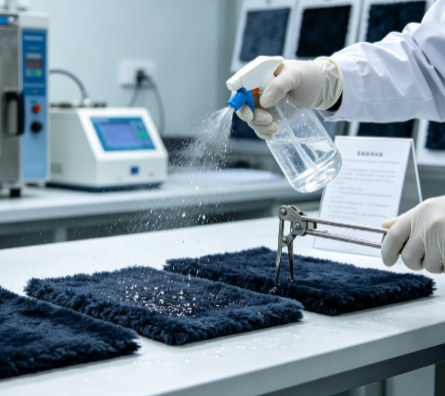
Pad-dry-cure is the most common method for durable flame retardants. The fabric is immersed in the finishing liquor, passed through squeeze rollers to remove excess liquor (the wet pick-up is typically 70–90% for plush), dried, and then cured at elevated temperature. The curing step is critical — it drives the chemical reaction between the flame retardant and the fiber, creating a durable bond.
Back-coating is the standard method for upholstery and plush fabrics where the hand feel of the pile must be preserved. A flame retardant formulation is applied to the back of the fabric using a knife-over-roll or screen-printing technique. The coating penetrates the base fabric but doesn't reach the pile surface. The result is a flame retardant barrier that doesn't affect the tactile quality of the pile.
Exhaustion is used for some flame retardant chemistries that have an affinity for specific fiber types. The fabric is immersed in a bath containing the flame retardant, and the chemical exhausts onto the fiber over time. This method is less common for plush because the liquor-to-goods ratio is high and the exhaustion efficiency is lower than for flat fabrics.
Performance Metrics
The flame retardant performance of plush fabrics is measured against the relevant standard for the application. For toys, EN 71-2 specifies a maximum flame spread rate of 30 mm/s for plush toy surfaces, with no molten droplets permitted. For upholstery, CRIB 5 (BS 5852) and California TB 117 are the common standards.
For flame retardant finishing, the key metric is the add-on percentage — the weight of flame retardant per unit weight of fabric. The typical add-on for phosphorus-based flame retardants is 3–8% of the fabric weight. Below 3%, the flame retardant is unlikely to provide adequate performance. Above 8%, the hand feel begins to suffer, and the cost increases significantly.
4. Anti-Static Finishing: Mechanisms, Measurement, and Durability
Anti-static finishing is essential for plush fabrics used in applications where static electricity is a problem: automotive interiors, electronics packaging, medical soft goods, and any application where the fabric contacts sensitive components or generates sparks.
The Mechanism
The principle of anti-static finishing is to increase the conductivity of the fiber surface, which allows static charges to dissipate before they build up to a problematic level.
There are two primary mechanisms:
Conductivity enhancement involves forming a hygroscopic layer on the fiber surface. The layer absorbs moisture from the air, and the moisture provides a conductive path for charge dissipation. The effectiveness of hygroscopic anti-static finishes depends on the humidity of the surrounding air — lower humidity means lower conductivity and greater static problems.
Charge neutralization involves the presence of mobile ions on the fiber surface. These ions can neutralize static charges as they form, preventing the charge buildup that leads to sparking and dust attraction.
Most anti-static finishes work through a combination of both mechanisms. Cationic anti-static agents — typically quaternary ammonium compounds — align with their hydrophobic groups away from the fiber surface, providing both lubrication (which reduces charge generation) and a hydrated layer at the air interface (which enhances charge dissipation).
Application Methods
For plush fabrics, anti-static finishes are typically applied by padding or exhaustion. The padding method involves immersing the fabric in the anti-static liquor, squeezing to the desired wet pick-up, and drying. The anti-static agent forms a film on the fiber surface.
A patent for an anti-static plush fabric describes the process: an anti-static agent, penetrating wetting agent, dispersing agent, and leveling agent are added into a dyeing solution, and the anti-static treatment is performed simultaneously with the dyeing process. This simultaneous dyeing and finishing approach reduces process steps and ensures uniform distribution of the anti-static agent throughout the pile.
For durable anti-static performance, the anti-static agent must be chemically bonded to the fiber or incorporated into a cross-linked polymer network. Non-durable anti-static agents are simply coated onto the surface and are removed by the first washing.
Performance Metrics
The anti-static performance of a fabric is measured by its surface resistivity, expressed in ohms per square (Ω/sq). The standard thresholds are:
Surface Resistivity | Classification | Typical Application |
< 10⁵ Ω/sq | Conductive | Electronics manufacturing, cleanrooms |
10⁵ – 10⁹ Ω/sq | Anti-static | Automotive interiors, medical textiles |
10⁹ – 10¹¹ Ω/sq | Static dissipative | General industrial |
> 10¹¹ Ω/sq | Insulating | Untreated synthetic textiles |
Untreated synthetic textiles typically show surface resistance values of approximately 10⁹–10¹⁰ Ω/sq, which is characteristic of insulating materials. After finishing with anti-static agents, the surface resistance decreases to the order of 10⁶–10⁷ Ω/sq, indicating improved charge dissipation.
A recent study on nano-carbon black anti-static coatings achieved surface resistance of 7.1 × 10⁶ Ω after treatment, and the resistance remained at 2.0 × 10⁹ Ω after washing — confirming excellent washing durability.
5. Waterproof and Water-Repellent Finishing: The PFAS Transition
Water repellent finishing for textiles is undergoing a fundamental transition driven by PFAS regulations. This is the most significant change in textile finishing chemistry in the past two decades, and it directly affects plush fabric manufacturers.
The PFAS Problem
Per- and polyfluoroalkyl substances (PFAS) have dominated the water repellent market for decades because their carbon-fluorine bonds create exceptionally low surface energy, producing excellent water and oil repellency. But PFAS are environmentally persistent and bioaccumulative, and they've been linked to health concerns.
The regulatory response has been swift. France's PFAS decree restricts PFAS in clothing textiles, footwear, and waterproofing agents effective January 1, 2026. The Danish Parliament has agreed on a national ban on PFAS in clothing, shoes, and impregnating agents as of July 1, 2026. The EU restriction proposal aims to ban the manufacture, use, and placing on the market of PFAS in the European Economic Area, with textiles and apparel water-repellent coatings explicitly identified as affected sectors.
The Fluorine-Free Alternatives
Fluorine-free water repellents replace fluorocarbon chains with long-chain alkyl groups. They fall into four main categories: polyacrylate-based, organosilicon-based (silicone), polyurethane-based, and dendritic polymer-based.
Silicone-based finishes are the most versatile and widely used non-fluorinated option. Methyl silicone oil — a common component of water repellent formulations for plush — creates a hydrophobic film on the fiber surface that repels water while maintaining a relatively soft hand feel.
Paraffin-based finishes combine paraffin wax emulsions with emulsifiers to create a water-repellent coating. Paraffin-based finishes are economical and provide good water repellency, but they're less durable than silicone or fluorocarbon finishes and can feel waxy on the hand.
A patent for waterproof plush describes a finishing formulation comprising 50–60 parts methyl silicone oil, 8–10 parts paraffin emulsion, and additional components including emulsifiers and stabilizers. The combination of silicone and paraffin provides both water repellency and a soft hand feel — the silicone reduces surface energy, while the paraffin adds bulk and water resistance.
Performance Metrics
Water repellency is measured by the spray rating test (AATCC 22 or ISO 4920), which evaluates how well the fabric sheds water droplets. The rating scale runs from 0 (complete wetting) to 100 (no wetting or sticking). For plush fabrics, a spray rating of 80 or higher is considered good water repellency.
Water resistance — the ability to resist water penetration under pressure — is measured by the hydrostatic head test (AATCC 127 or ISO 811). This is less relevant for plush fabrics than for technical textiles, because plush is rarely used in applications requiring high hydrostatic resistance. But for plush used in outdoor or wet environments, a minimum hydrostatic head of 300–500 mm is a reasonable target.
6. The Combination Challenge: When Three Treatments Compete
This is the section where the engineering gets difficult. Applying all three treatments to the same plush fabric isn't simply a matter of sequential application. The treatments interact, and those interactions determine whether the final product meets all three specifications.
Interaction 1: Water Repellency vs. Anti-Static Performance
This is the most fundamental conflict. Anti-static finishes work by increasing surface conductivity, which depends on moisture absorption. Water repellent finishes work by reducing surface energy, which prevents water from wetting the surface.
If the water repellent is applied first and forms a continuous hydrophobic film, the anti-static agent can't reach the fiber surface to form its conductive layer. The anti-static performance is compromised or eliminated.
If the anti-static agent is applied first, the water repellent may disrupt the conductive layer, reducing anti-static performance.
The practical solution is to use an anti-static chemistry that doesn't depend solely on moisture absorption — such as a conductive polymer or a nano-carbon based coating — and to apply the water repellent in a way that doesn't completely encapsulate the fiber. A discontinuous or semi-continuous water repellent film allows some moisture access for the anti-static mechanism while still providing water beading.
Interaction 2: Flame Retardancy vs. Water Repellency
Flame retardants and water repellents can also conflict. Many intumescent flame retardant systems depend on the formation of a coherent char layer when exposed to heat. If the fabric surface is coated with a hydrophobic water repellent, the char formation may be disrupted — the water repellent can act as a fuel source rather than promoting char formation.
The back-coating approach solves this problem for flame retardants. By applying the flame retardant to the back of the fabric and the water repellent to the face, the two chemistries don't interfere with each other. The flame retardant works on the side where ignition is most likely (for upholstery), while the water repellent works on the side that's exposed to the environment.
Interaction 3: Hand Feel Degradation
Every finish added to the fiber surface changes the hand feel. Flame retardants make the pile stiffer. Anti-static agents can feel greasy. Water repellents can feel slick. When all three are applied, the cumulative effect can turn a soft, luxurious plush into something that feels more like a technical textile than a comfort product.
The formulator has to balance performance against hand feel. One approach is to use lower add-on levels of each finish and compensate with process optimization. Another is to use multi-functional chemistries that provide more than one benefit from a single finish — such as a phosphorus-nitrogen intumescent that provides flame retardancy while also contributing to anti-static performance through its ionic character.
The Process Sequence
The sequence of application matters. The general rule is to apply the finish that requires the most durable bond first, and the finish that's most sensitive to process conditions last.
A typical sequence for a plush fabric requiring all three functions:
Dyeing and anti-static application (simultaneous, if the chemistry allows)
Flame retardant back-coating (applied to the back of the fabric)
Water repellent finishing (applied to the face, with careful control of penetration)
The exact sequence depends on the specific chemistries and the fabric construction. The key is to test the combination at the lab scale before committing to production.
7. Regulatory Requirements: What Your Market Actually Demands
The regulatory requirements for functional plush fabrics depend on the application and the market. Here's the hierarchy I use when evaluating compliance requirements.
Toy Safety: EN 71-2 and GB 6675.3
For plush toys, flammability is the primary regulatory requirement. EN 71-2 specifies that plush toy surfaces must have a maximum flame spread rate of 30 mm/s, with no molten droplets permitted. The test involves applying a flame to the surface of the toy material and measuring the rate of flame spread.
China's GB 6675.3-2025, which takes effect November 1, 2026, updates the flammability requirements for soft-filled toys. The new standard refines the test methods for plush and flowing materials, and expands the classification of head-worn toys to distinguish between different lengths of pile and flowing materials.
Automotive: FMVSS 302 and OEM Specifications
For plush fabrics used in automotive interiors, FMVSS 302 specifies a maximum horizontal burn rate of 100 mm/min. This is less stringent than EN 71-2 for toys, but automotive OEMs often impose additional requirements — including VOC limits, odor testing, and fogging resistance.
Upholstery: CRIB 5 and California TB 117
For plush upholstery fabrics, CRIB 5 (BS 5852) is the standard for contract furniture in the UK, and California TB 117 is the standard for residential upholstery in the US. Both standards require the fabric to resist ignition from a specific ignition source (a crib in CRIB 5, a smoldering cigarette or small flame in TB 117).
PFAS Restrictions
The PFAS regulatory landscape is evolving rapidly. France's PFAS decree restricts PFAS in clothing textiles, footwear, and waterproofing agents effective January 1, 2026. The Danish Parliament has agreed on a national ban on PFAS in clothing, shoes, and impregnating agents as of July 1, 2026. The EU restriction proposal aims to ban PFAS across the European Economic Area, with textiles explicitly identified as an affected sector.
For plush fabric manufacturers, this means that any water repellent containing PFAS — including the long-chain fluorocarbon chemistries that have been the industry standard — must be replaced with fluorine-free alternatives for products destined for the European market.
Anti-Static Requirements
Anti-static requirements vary by application. For electronics packaging, surface resistivity must be below 10⁹ Ω/sq. For automotive interiors, the requirement is typically below 10¹¹ Ω/sq. For medical textiles, the requirement depends on the specific application and the risk of static discharge.
8. Testing and Verification: What to Measure and How
The performance of functional plush fabrics is verified through a combination of physical testing and chemical analysis. Here's the testing framework I use when evaluating finished plush products.
Flame Retardancy Testing
Test Method | What It Measures | Typical Acceptance Criteria |
EN 71-2 (horizontal) | Flame spread rate on plush toy surface | ≤30 mm/s |
GB 6675.3 | Flame spread rate | ≤30 mm/s, no molten droplets |
FMVSS 302 | Horizontal burn rate | ≤100 mm/min |
UL-94 (vertical) | Self-extinguishing behavior | V-0 for back-coated upholstery |
Cone calorimetry | Peak heat release rate, MARHE | Depends on specification |
The cone calorimetry test is particularly valuable for evaluating the effectiveness of intumescent flame retardants. The NEXP/D formulation mentioned earlier achieved reductions of up to 68% in peak heat release rate and 85% in MARHE (maximum average rate of heat emission). These are meaningful performance metrics that predict how the fabric will behave in a real fire.
Anti-Static Testing
Test Method | What It Measures | Typical Acceptance Criteria |
Surface resistivity (AATCC 76) | Electrical resistance of fabric surface | <10⁹ Ω/sq for anti-static |
Static decay (FTMS 101B Method 4046) | Time for charge to dissipate | <0.5 seconds for anti-static |
Charge generation | Charge buildup under friction | Depends on application |
Surface resistivity is the most common metric for anti-static performance. It's measured by placing two electrodes on the fabric surface and measuring the resistance between them. The result is expressed in ohms per square (Ω/sq).
Water Repellency Testing
Test Method | What It Measures | Typical Acceptance Criteria |
Spray rating (AATCC 22 / ISO 4920) | Water beading and shedding | ≥80 for good repellency |
Hydrostatic head (AATCC 127 / ISO 811) | Water penetration resistance | ≥300 mm for water-resistant plush |
Bundesmann (ISO 9865) | Rain resistance | Depends on application |
The spray rating test is the most common method for evaluating water repellency on plush fabrics. A water spray is applied to the fabric surface, and the wetting pattern is compared to a standard rating chart.
Hand Feel Evaluation
Hand feel is a subjective assessment, but it's critical for plush fabrics. The standard method is a paired comparison test — the finished fabric is evaluated against an untreated control, and a panel of evaluators rates the softness, stiffness, and overall tactile quality. For quantitative assessment, instruments such as the Kawabata Evaluation System (KES) can measure surface friction, bending stiffness, and compressional properties.
Chemical Compliance Testing
Test | What It Verifies | Standard |
PFAS screening | Absence of fluorine-containing compounds | Total fluorine analysis, targeted PFAS analysis |
Formaldehyde | Residual formaldehyde content | ≤75 ppm for textiles |
Heavy metals | Lead, cadmium, mercury, chromium | REACH, CPSIA limits |
APEO | Alkylphenol ethoxylates | REACH restriction |
9. Real-World Case: Phytic Acid and Biopolymer Synergy for Flame-Retardant and Anti-Static Acrylic
Let me share a case that illustrates how a single finishing system can deliver both flame retardancy and anti-static performance.
The Challenge: Researchers were working with acrylic fabrics — a fiber that's inherently flammable and prone to static buildup. The goal was to develop a finishing system that would provide both flame retardancy and anti-static performance without using halogenated compounds or compromising the hand feel of the fabric.
The Approach: The team adopted a synergistic approach using phytic acid (PA) — a naturally occurring phosphorus compound found in plant seeds — combined with a protein biopolymer. The protein biopolymer was either keratin (derived from wool) or sericin (derived from silk).
The phytic acid provided the phosphorus-based flame retardant mechanism. When exposed to heat, the phosphorus compounds promote char formation and reduce the formation of flammable volatiles. The protein biopolymer provided a synergistic effect — the nitrogen-containing amino acids in the protein interacted with the phosphorus compounds to enhance the flame retardant performance. The protein biopolymer also contributed to the anti-static performance through its hydrophilic character.
The Results: The treatment boosted resistance to flame, ultraviolet rays, and electrostatic charges while enhancing the hydrophilicity of the acrylic fabric. The combination of phytic acid and the protein biopolymer created a synergistic effect that neither component could achieve alone.
Why This Matters: The phytic acid–protein biopolymer system demonstrates that functional finishing doesn't have to be a zero-sum game. The anti-static performance — which depends on moisture absorption — was enhanced by the same treatment that provided flame retardancy. The hydrophilic character of the protein biopolymer improved the anti-static mechanism rather than conflicting with it.
For plush fabric manufacturers, this approach offers a template for combination finishing. Instead of applying separate flame retardant and anti-static finishes that compete with each other, a single synergistic system can deliver both functions. The key is selecting chemistries that reinforce each other rather than conflict.
The limitation is durability. Phytic acid treatments have shown good flame retardancy after 20 washes in some formulations, but the durability depends on the specific application method and the fiber type. For plush fabrics that require durable performance, the treatment may need to be combined with a binder system or applied as a back-coating.
10. What to Verify When Sourcing Functional Plush Fabrics
Based on years of evaluating finished plush products and supplier capabilities, here's the verification framework I use.
Flame Retardant Performance
Check | What to Request | Red Flag |
Test report | EN 71-2 or GB 6675.3 test report from accredited lab | No test report; generic compliance statement |
Add-on percentage | Flame retardant add-on data (target 3–8% for durable FR) | Cannot specify add-on |
Durability data | Performance after 5–10 washes | Only initial performance data |
Chemistry identification | Type of flame retardant (phosphorus, nitrogen, intumescent) | "Proprietary" formulation without chemistry disclosure |
Hand feel assessment | Physical sample for evaluation | Only digital photos |
Anti-Static Performance
Check | What to Request | Red Flag |
Surface resistivity | Measured value in Ω/sq (target <10⁹ for anti-static) | No measurement data |
Durability after washing | Resistivity after 5–10 washes | Only initial performance data |
Mechanism identification | Conductive additive or hygroscopic finish | Cannot explain the mechanism |
Humidity dependence | Performance at 25% RH and 65% RH | Only tested at 65% RH |
Water Repellency
Check | What to Request | Red Flag |
PFAS declaration | Statement of no intentionally added PFAS | No PFAS documentation |
Spray rating | AATCC 22 or ISO 4920 test data (target ≥80) | Visual assessment only |
Durability after washing | Spray rating after 5–10 washes | Only initial performance data |
Chemistry type | Silicone, paraffin, polyurethane, or dendritic polymer | "Fluorine-free" without specifying chemistry |
Chemical Compliance
Check | What to Request | Red Flag |
PFAS screening | Total fluorine analysis report | No PFAS testing |
Formaldehyde | Residual formaldehyde test report (≤75 ppm) | No formaldehyde data |
Heavy metals | REACH and CPSIA compliance documentation | Generic certificate without test data |
APEO screening | APEO test report | No APEO testing |
Combined Performance
Check | What to Request | Red Flag |
Full system test | All three functions tested on the finished fabric | Testing on individual finishes, not the combination |
Interaction testing | Evidence that the finishes don't degrade each other | No interaction data |
Hand feel evaluation | Physical sample for tactile assessment | Only test data, no physical sample |
11. Common Questions About Functional Plush Fabric Treatments
Q: Can all three treatments — flame retardant, anti-static, and waterproof — be applied to the same plush fabric?
Yes, but with careful chemistry selection and process sequencing. The main conflict is between water repellency and anti-static performance, because water repellents reduce surface conductivity while anti-static finishes depend on it. The practical solution is to use an anti-static chemistry that doesn't rely solely on moisture absorption, and to apply the water repellent in a way that doesn't completely encapsulate the fiber.
Q: What flame retardant chemistry is best for plush toys?
Phosphorus-based and intumescent systems are the most common for plush toys. The intumescent approach can be applied as a back-coating, which preserves the hand feel of the pile surface. The target performance is a flame spread rate ≤30 mm/s per EN 71-2 or GB 6675.3.
Q: How do I measure anti-static performance on plush fabric?
Surface resistivity is the standard metric, measured per AATCC 76. The target for anti-static performance is below 10⁹ Ω/sq. Untreated synthetic plush typically measures 10⁹–10¹⁰ Ω/sq. After anti-static finishing, the resistivity should drop to the 10⁶–10⁷ Ω/sq range.
Q: What's the PFAS situation for water repellent plush fabrics?
PFAS-based water repellents are being restricted globally. France's PFAS decree restricts them in clothing and waterproofing agents effective January 2026. The EU is moving toward a broader restriction. For plush fabrics destined for the European market, fluorine-free alternatives — silicone-based, paraffin-based, polyurethane-based, or dendritic polymer-based — are the practical choice.
Q: Does the flame retardant finish wash out?
It depends on the chemistry and the application method. Non-durable flame retardants that are simply coated onto the surface will wash out within a few launderings. Durable flame retardants that are chemically bonded to the fiber or applied as a back-coating with a binder system can withstand 20+ washes. The test data should specify the number of washes the performance is rated for.
Q: How does anti-static performance change with humidity?
Hygroscopic anti-static finishes depend on moisture absorption for their conductivity mechanism. At low humidity (below 30% RH), the performance degrades significantly. For applications in low-humidity environments, a conductive additive (such as nano-carbon or a conductive polymer) is more reliable than a hygroscopic finish, because the conductivity mechanism doesn't depend on atmospheric moisture.
Q: What's the hand feel impact of these finishes?
Every finish changes the hand feel to some degree. Flame retardants tend to make the pile stiffer. Anti-static agents can feel slightly greasy. Water repellents can feel slick. The cumulative effect depends on the add-on levels and the specific chemistries. The best approach is to evaluate a physical sample of the finished fabric against an untreated control, and to specify the hand feel requirement as part of the purchase specification.
Q: Can I use a single finishing system for all three functions?
There are multi-functional finishing systems that provide two or more functions from a single chemistry. The phytic acid–protein biopolymer system described in the case study provides both flame retardancy and anti-static performance. Silicone-based finishes can provide water repellency and some anti-static benefit through lubrication. But for full performance across all three functions, a combination of chemistries is usually required.
12. Final Thoughts
Functional finishing for plush fabrics isn't about finding the single best chemistry for each function. It's about finding a combination of chemistries and a process sequence that delivers all three functions without compromising the hand feel that makes plush desirable in the first place.
Here's what I'd tell anyone specifying or sourcing functional plush fabrics:
Start with the application and work backward to the chemistry. A plush toy needs flame retardancy per EN 71-2 or GB 6675.3. An automotive interior needs anti-static performance and low VOC. An outdoor plush product needs water repellency and PFAS compliance. The application determines which functions are critical and which standards apply.
The combination is harder than the individual finishes. Water repellency and anti-static performance conflict at the fundamental level. Flame retardants and water repellents can interfere with each other. Test the combination on the finished fabric, not the individual finishes in isolation.
PFAS compliance is not optional. The regulatory direction is one-way. For products destined for the European market, fluorine-free water repellents are the only viable option. Request PFAS documentation and verify it independently.
Hand feel is a performance specification. On plush fabric, the tactile quality is part of the product's value. Evaluate a physical sample. Don't accept test data alone as proof that the fabric meets the hand feel requirement.
Verify the durability data. A finish that performs on the first day but fails after five washes is not a functional finish. Request test data after 5–10 washes for all three functions. If the supplier can't provide it, that's a gap.
The functional textile finishing market is evolving rapidly, driven by regulatory pressure and by consumer demand for safer, more sustainable products. The plush fabric manufacturers who invest in the right chemistries, the right process controls, and the right testing infrastructure will be the ones who can deliver products that meet the performance requirements without sacrificing the softness and comfort that plush is known for.
Need Custom Fabric Solutions?
We can customize colors, textures, and specifications to meet your exact requirements.
Contact Us